


Flipping the Bill: How a neighbor’s complaint about ducks made them legal in Tualatin
“One of the neighbors peeked over the fence and made a complaint that there were strange birds, and that prompted this,” said Tualatin resident Kevin Mulvaney, who has, since last June, led the charge on adding specification to Tualatin’s domestic fowl laws.
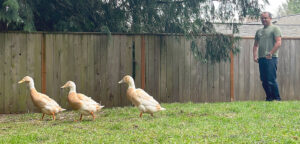
In June of 2025, Mulvaney and his daughter received a complaint about the Runner Ducks they had been rearing in their backyard. Mulvaney, who attributed his decision to own ducks to his daughter, said that before acquiring the animals, they tried to track down Tualatin’s regulations on owning the birds without much luck.
“We looked through the code, and the only thing we could find was the chicken law as it’s written,” Mulvaney said. “We thought, ‘well, it doesn’t say that we can’t.’”
After receiving the complaint, Mulvaney brought the existing code back to the city in July 2025 and asked that the ordinance’s vague stance on waterfowl be addressed.
The City of Tualatin has well-defined rules on chicken ownership, which require owners to obtain a five-year license, limit household hens to four, and prohibit roosters. However, rules for ducks and other domestic fowl were not even mentioned in the code.
At their meeting on Monday, March 23, City Councilors voted, 4-3, to amend the city’s development and municipal code to include new types of domestic fowl ownership within Tualatin’s R1 zone. The licensing requirements for the new birds are identical to those required for chicken ownership.
“In this proposal, we include chickens, ducks, pheasants, pigeons, quails, partridges, doves and similar birds for personal use,” Tualatin Senior Planner Erin Engman told council at their first public hearing for the ordinance on March 9. “Some of the birds on our prohibited list include roosters, geese, guinea fowl, peacock, turkeys, emus and ostriches.”

The new domestic fowl specifications tightened the prohibition on animals such as emus and guinea fowl, citing that the outlawed birds were loud and potentially dangerous in an urban setting.
According to Engman, Tualatin currently has 28 active domestic fowl licenses and has received eight complaints since 2021.
At the March 9 meeting, city planners highlighted Tualatin’s new domestic fowl regulations in relation to other Oregon cities, emphasizing how many species were accounted for in the ordinance.
Councilors were inquisitive and largely supportive of the ordinance update at the first public hearing, except for councilor Maria Reyes, who voted no and expressed concern about avian-borne viruses.
“I just feel that what we have in our ordinance is enough,” Reyes said. “I’m concerned about that too, about viruses in the air.”
On March 23, Councilor Octavio Gonzalez also argued that the ordinance change would be a detriment to neighborhood quality of life, citing sanitation concerns, noise pollution and the potential for attracting vermin.
“The concern is not the birds themselves, but the cumulative impact they create over time,” Gonzalez started. “While keeping these birds might begin as a personal use activity, the combined concerns of noise, waste, health concerns, pest attractions and property impact can expand beyond a single property line.”
Gonzalez said that although he had empathy for residents interested in greater domestic fowl diversity within the city, he reasoned that the cumulative concerns of permitting more species was “an issue” and worried the city wouldn’t be able to enforce domestic fowl guidelines.
Council President Valerie Pratt countered Gonzalez and Reyes’ concerns, explaining that she thought the amended code did a better job regulating domestic fowl because it was more detailed and specific.
“I think this actually sets up a better ordinance for our community,” Pratt said. “I think this gives a little more strength to enforcing the issues…we have to have a balance here, and I think that was very well thought out in this ordinance.”
Councilor Cindy Hillier also said she supported the amended ordinance but thought the city should conduct an “annual or biannual check” on licensed properties to make sure owners were following regulations, as well as increasing domestic fowl licensing fees to pay for city check-ins.
“I’m pretty stoked. I told my daughter, and she was ecstatic,” Mulvaney said to Tualatin Life after the vote.
Mulvaney said his goal in bringing the code to the council was to add clarity, and he was glad that councilors were supportive of the endeavor. He added that he would “totally support” Hillier’s idea for the city to check in on birdowners annually and possibly raise licensing fees to fund the initiative.
“That would make a lot of sense,” Mulvaney said. “Treating any pet well and checking in on them is key…Let’s pay for ourselves to be governed by the city and not our neighbors because neighbors governing never goes well.”