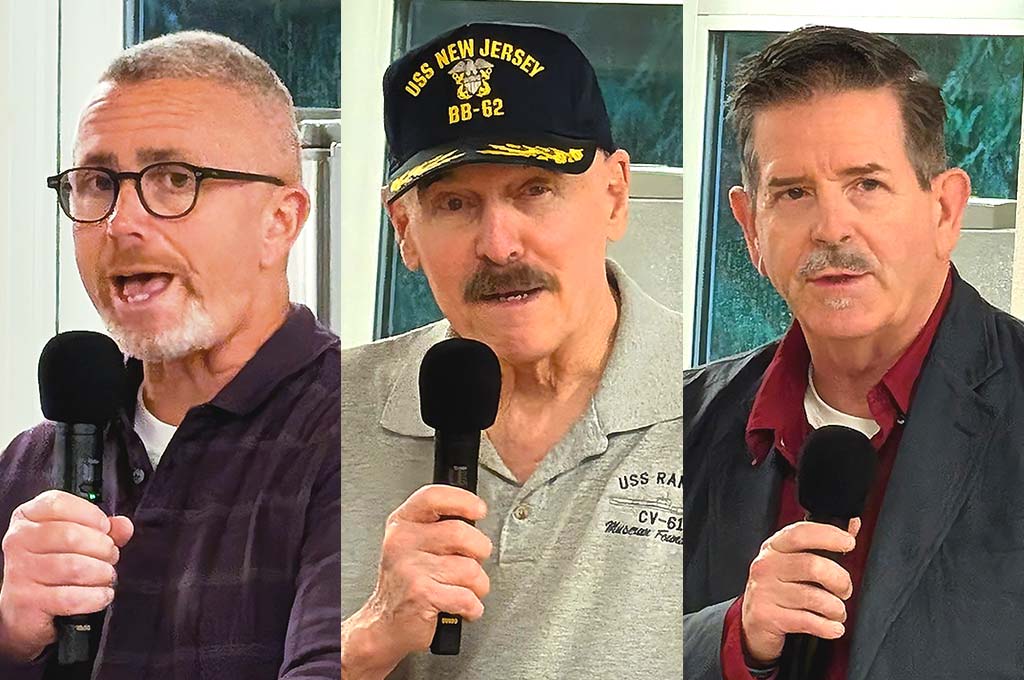

At the annual City of Tualatin Veterans Day breakfast at the Juanita Pohl Center on Nov. 10, three veterans with decades of military experience shared their stories of friends, family, and the complicated relationship between military service and American society.
Amid the lingering aromas of the sumptuous meal prepared by the Tualatin Kiwanis Club and served by Lam Research volunteers, Mayor Frank Bubenik, a U.S. Army veteran, emceed the event.
Learning to Adapt
Retired Army Master Sgt. Jesse Thompson led off with one of his most vivid memories from his 2004 deployment to Iraq.
During his first week at Camp Anaconda, about 40 miles north of Baghdad, he awoke to the sounds of explosions. He later found out it was incoming mortar and rocket fire.
“It scared the hell out of me, and I prayed that I wouldn’t die,” he said. But the barrage was just a part of life at the camp, nicknamed “Mortaritaville.”
One morning about a year later, Thompson stood outside the supply shack, barely reacting as mortar fire whistled and exploded nearby. He watched blandly as a new soldier from an incoming replacement unit sprinted toward a bunker, helmet and equipment flying in different directions.
Service members learn to adapt to circumstances most people would find unimaginable, he said. “Things that once terrified us eventually become part of the routine,” he said.
Some of Thompson’s most meaningful reflections had little to do with combat. When deployment orders sent his unit to Iraq, his future wife moved their wedding up on very short notice, somehow squeezing in a courthouse date on Valentine’s Day. A supply clerk attended, while a motor sergeant served as both photographer and witness.
“It is not exactly the wedding that we had originally envisioned, but it got the job done,” Thompson said. “It pretty much set the tone for the rest of our lives together.”
The couple raised three daughters and moved five more times during his military career. His middle daughter attended three high schools in three different states.
Military families, he said, make sacrifices that often go unrecognized.
“When people thank me for my military service, I’m always appreciative,” Thompson said. “But I ask that they recognize something more important.”
Spouses, children, parents and siblings endure deployments, missed birthdays and holidays, uncertainty and frequent moves.
“Unlike the veteran, they weren’t the ones who raised their hands to volunteer. But they, too, served. They just did it without a uniform.”
A Life Shaped by Service
Retired Navy officer Tim Myers’ connection to military service began before he was old enough to understand it. Born in August 1941, he was just 4 months old when the attack on Pearl Harbor prompted his father to enlist. His father did not return home until Myers was 5.
Myers later attended the U.S. Naval Academy, playing football and baseball. During his senior year, a professor interrupted a test to announce President John F. Kennedy – a Navy veteran – had been assassinated.
One of Myers’ great honors was being selected as one of just 120 midshipmen out of 4,500 to march in Kennedy’s funeral procession in Washington, D.C.
Myers went on to serve 30 years in the Navy, with assignments that included reconnaissance missions, test pilot school, weapons systems testing and command positions. His career also included breaking aviation records previously held by Russian crews, including a high-altitude flight reaching 46,000 feet.
He retired after commanding the amphibious assault ship USS Peleliu, named for one of World War II’s bloodiest battles. Coincidentally, the decommissioned Peleliu was sunk off Hawaii in a live-fire exercise earlier this year.
After retiring, Myers was recruited to establish Navy Junior ROTC programs at six Chicago high schools struggling with discipline problems. Working with a handpicked team, he helped turn many students’ lives around.
Myers also acknowledged the personal cost of his military career. He and his wife had four children during their first four years of marriage, but frequent absences placed enormous strain on their relationship, eventually leading to divorce.
“I could see what she was saying. It was very, very hard,” he said.
We’re All in This Together
Retired Navy Senior Chief Petty Officer Sean Warren offered a different perspective.
He thanked those who organized the breakfast and support veterans, but also thanked Americans who question military policy, oppose the use of force, or object to the cost of maintaining the nation’s armed forces.
“If not for the reticence and objections of these Americans, our republic might have yielded to a quasi-militarization in any number of historical conflicts,” he said.
Such skepticism helps preserve the country’s democratic character and its rejection of tyranny, he said, adding that he was happy to defend those viewpoints every time he put on his uniform.
“And anyway, you no doubt paid your taxes, which supported my service, and now my Navy retirement, so thanks for that,” he added with humor.
He closed with a message that captured the morning’s broader theme: “Thank you for your service. Thank you for supporting our service. Thank you for not supporting our service. In the end, we’re all in this together.”
The sacrifices made by veterans, and the families who stand beside them, have helped preserve the freedoms Americans enjoy today. Their service, courage and commitment deserve not only our gratitude on Veterans Day, but our appreciation every day.