
At their Aug. 24 meeting, Tualatin City Councilors were presented with an early analysis of the Tualatin-Sherwood Road Crossing project, where city engineers said that most of their options contained a “fatal flaw.”
“Originally when we scoped this, I thought there’d be a lot more grade separation options,” City Engineer Mike McCarthy said. “So I was surprised that all but one of their options ran into a fatal flaw in one way or another.”
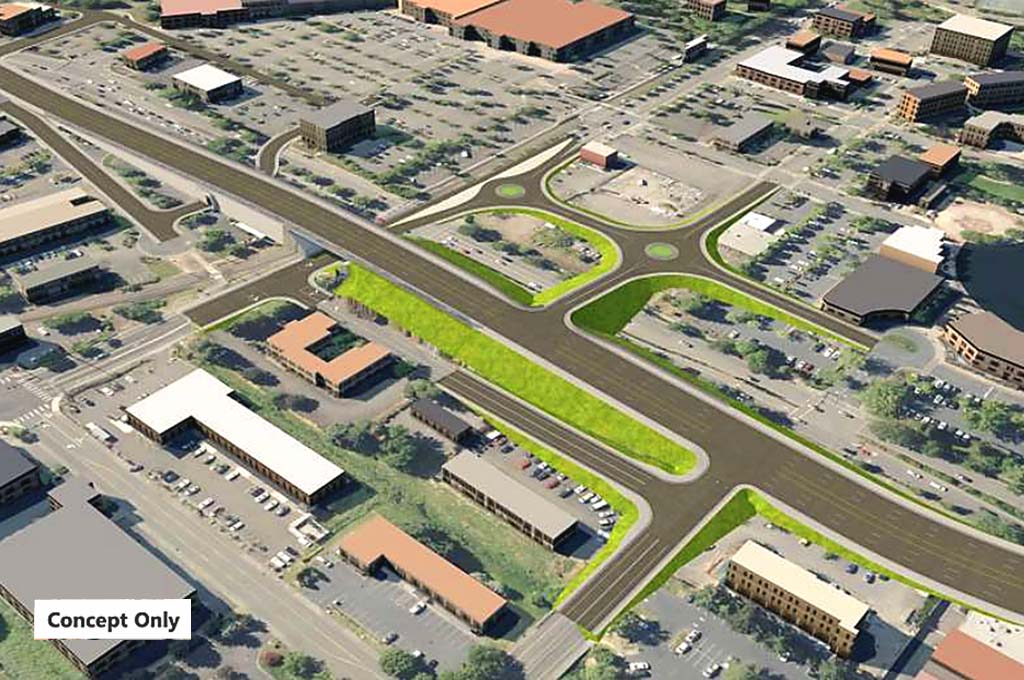
The project envisions relieving a traffic bottleneck at the intersection of Tualatin-Sherwood Road, Boones Ferry Road and the Portland and Western Railroad, by raising Tualatin-Sherwood Road over everything.
Tualatin-Sherwood Road was ranked in the 10th percentile of roadways with frequent car crashes in Washington County, by the Oregon Department of Transportation.
“Tualatin-Sherwood Road today, there’s a lot of times that you come to a complete stop,” said Project Manager Marc Butorac from Kittelson and Associates. “In this scenario, Tualatin-Sherwood Road, at least between Fred Meyer and 90th, that’s gonna be pretty much free-flow.”
The study showed that city staff thought a road over approach, raising Tualatin-Sherwood Road over Boones Ferry Road and the railroad, maintaining local connections and shifting the road to the south, was their most viable solution.
While this option was favored by city staff, they still reported that the project failed to positively impact the community.
The project was estimated to cost $250 million, with costs increasing because of the extensive construction required to realign the road, construct two new roundabouts and relocate surrounding businesses.
“The reason it’s cheaper than moving it south is we don’t have to pick up those six properties to the south,” Butorac said about the option that maintained the road’s current alignment. “That adds at least $35 million in right-of-way expenses potentially from that scenario.”
Every other version of the project presented to councilors, besides leaving the intersection as is, were, according to city staff, fatally flawed in some way.
A road-over-approach, where Tualatin-Sherwood Road is raised while the existing alignment is maintained, was deemed unachievable due to the extensive construction required.
“You’d have Tualatin-Sherwood, basically one lane in each direction for about 18 months,” Butorac said. “That, we determined, really isn’t a viable option.”
At-grade improvements, such as widening Tualatin-Sherwood Road, were not seen as lasting improvements, as traffic would likely return within the next 20 years, according to city engineers.
Butorac and McCarthy also told councilors that even if they elected to follow through with the road-over option, seen as most feasible, it would create another traffic bottleneck further down the line at Tualatin-Sherwood Road and 90th Avenue.
“From 90th west we’re not gonna change anything, and it’s going to continue to deteriorate,” Butorac said. “After this improvement, the pain will be at 90th because that will then be the bottleneck.”
Councilors expressed concerns over the current state of the project and suggested other options, like raised pedestrian paths, and told city and project engineers to continue analyzing the project.
“The hard one for me was the number one thing you got feedback on was community development and none of these meet that criteria,” Council President Valerie Pratt told presenters.
“It will get worse. It will get a lot worse,” Councilor Bridget Brooks said. “I don’t know if it (grant funding) will always be an opportunity that’s here for us.”
McCarthy told the council that the project would still be a good candidate for funding from the Rail Crossing Elimination grant and that the planning department will be holding a virtual open house for the project from Sept. 14 to Sept. 28, where community members could learn more about the proposed project and potential ways to address traffic.