
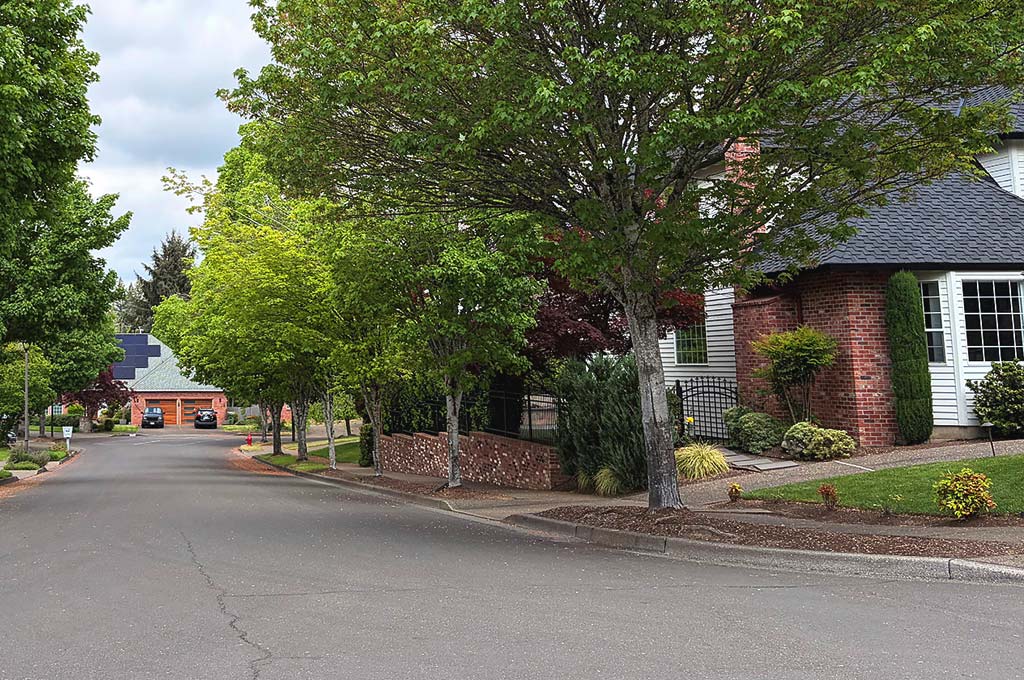
Over 300 residential trees and 1,000 sidewalk panels will be excavated starting this summer.
At their May 26 meeting, Tualatin City Council voted 6-1 to approve the city’s Sidewalk Maintenance Backlog Project, with construction kickoff planned for late June.
The project, which draws on a recently completed sidewalk analysis (2025), aims to make all residential sidewalks ADA-compliant and involves most of Tualatin’s neighborhoods. The city will install root barriers around new trees to prevent root damage and use low-emissions concrete for new panels.
“The city did a whole analysis of the city a couple of years back and identified over 300 qualifying defects that aren’t within the ADA compliance standards that we need to abide by,” Tualatin Street Division Manager James Skogen told Tualatin Life. “They basically found, I want to say, around 150 defects that we have listed here that we’re gonna be commencing this summer.”
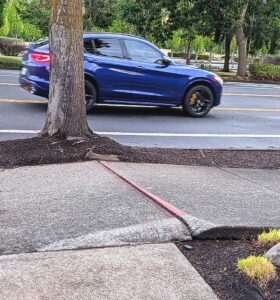
The City of Tualatin’s Sidewalk Maintenance Program (tinyurl.com/7ecnuefw), which was started in 2001, classifies sidewalks with lifts over a quarter of an inch and sidewalks damaged by street trees as noncompliant.
“Any lip of the sidewalk greater than a quarter of an inch is actually out of compliance,” Skogen said.
“These were all different kinds of defects,” said Project Manager Lindsay Marshall about the recent survey at the May 26 council meeting. “There’s just over 2,000 defects that we logged into our total and this lifting, crackling or crumbling.”
Marshall told councilors that sidewalks have “an average lifespan of 25-50 years” and that most of Tualatin’s residential sidewalks and street trees were at the tail end of that interval.
“Sidewalks and street trees are the responsibility of the homeowner in Tualatin, however, a lot of homeowners and property owners aren’t addressing those sidewalk defects, often because they don’t know that that is their responsibility sometimes and often because it can get really expensive,” Marshall said.
The total project was estimated to cost the city $1.4 million and was broken into two phases: phase one, set to start on June 29, and phase two, set for next summer.
At the May 26 meeting, Marshall told the council that funding for Tualatin’s Sidewalk Maintenance Program is “falling behind” and significantly slowing down their maintenance cycle.
“We’ve gone from a three-year cycle to a nine-year-cycle around the city,” Marshall said. “That means we fixed your sidewalk and then we’re not there to check again for almost 10 years, which is quite a while.”
Marshall mentioned that a nine-year interval without upkeep would result in tree roots doing more significant damage to sidewalk panels.
“Even in a couple of years, the root can push that panel up since the last time we looked at it,” Marshall told Tualatin Life. “You wouldn’t end up with a giant lift if you looked every three years because you could catch it.”
The program has an annual budget of $150,000, which is estimated to cover only 10 to 15% of the defects identified each year. This summer, in addition to sidewalk replacement and repair, Marshall and Skogen will replace homeowners’ trees and give them the opportunity to select their replacements.
Homeowners in selected project zones will be able to select their new tree from a selection of 40 trees featured in the city’s “adaptive street tree list (tinyurl.com/mt5behxy),” which includes nearly 10,000 trees. Marshall said the city hoped to curate a diverse selection of street trees by allowing residents to choose from the city’s list.
“About 50% just said that the city could choose,” Marshall said. “We actually only had two trees on that full list that were not chosen by someone.”
Sidewalk repairs kicked off on June 29 and are slated to continue through the summer, while tree planting will begin in November.
“We’re gonna do sidewalk fixing in summer,” Marshall said at the meeting. “Then we’ll plant the trees later in November, and then we’ll do the next zone the next year, so it’s a two-year project.”
While most councilors were in support at the May 26 city council meeting, Tualatin City Councilor Octavio Gonzalez, who is a licensed landscape professional, voted against the project, explaining that he did not feel like he had all the necessary information to support the initiative and that the expansive list of street tree options could create more labor problems in the future.
“The goal is to create less labor, less time,” Gonzalez told Marshall and Skogen, bringing up the maintenance involved with steel magnolia trees. “That would be the wrong tree, in my experience. So I don’t understand why we have so many tree choices.”
Marshall and Skogen told councilors they would be returning with a revamped proposal for phase two of the project in Spring of 2027. After the project’s completion, Marshall explained that the city planned to implement a cost-sharing model to finance future sidewalk maintenance.